 / Case studies /
 / Case studies /
 New patient task experience
 User research
Accessibility
UI
User research
Accessibility
UI
Current Health had flourished in the acute care space. Growth in this area had been fuelled by COVID when hospital at home had become a necessity rather than a nice-to-have. Post-COVID the market had continued to grow however it wasn’t without its risks. The Acute Hospital Care at Home waiver (AHCAH) from CMS that provided the funding for this type of care was only extended for short periods each time and its long term future was unclear. As a result Current Health made the strategic decision to develop its Chronic Care offering.
Having decided on a Chronic Care strategy, Current Health needed an initial condition to focus on. As part of the Product Design Leadership team, I worked closely with Product and Engineering directors to identify a chronic condition (or conditions) that would allow Current Health to start building out its Chronic Care offering.
 Created an interview script for depth interviews with customers
Facilitated customer interviews
Conducted desk research on chronic condition prevalence and the impact on customers in terms of cost and
resource
Ran a cross-functional workshop with Product, Engineering and Clinical to align on prioritisation criteria
Synthesised findings and presented to C-suite to align on direction
Type 2 diabetes represented the highest cost in terms of health care dollars for a single disease in the US
Mismanaged diabetes cost $306.6 billion in 2022, with hospital inpatient costs serving as the primary driver
Long-term complications of mismanaged diabetes further increased these costs
Related conditions, like gestational diabetes, offered additional opportunities
Customers had existing diabetes programs but these were admin-heavy, requiring manual work to record
readings
C-suite agreed on initial direction
Pursue diabetes as our first chronic condition, and begin discovery on monitoring approaches and devices.
With diabetes selected as our focus, we needed to understand the trade-offs between continuous and spot monitoring, and assess which best meets the needs of patients and clinicians.
Created an interview script for depth interviews with clinicians
Facilitated clinician interviews
Audited available monitoring technologies and their device ecosystems
Created and ran a patient survey and analysed results
Continuous monitoring (CGM) offered multiple benefits (e.g. trend analysis) but its cost at the time
represented a major barrier
Spot glucose monitoring offered a lower price point and a simpler integration. While the use cases were
narrower, it offered a viable solution for at-risk and newly diagnosed patients, along with conditions like
gestational diabetes
Long-term complications of mismanaged diabetes further increased these costs
A staged approach would let us reach patients sooner and learn before committing to the more complex CGM
integration
Integrate a spot blood glucose device first to meet immediate needs, and follow with a continuous device.
With spot monitoring selected, we needed to evaluate available devices and select the one that best met the needs of patients and clinicians, based on user experience, clinical fit and commercial viability.
Designed a device evaluation process and templated it for the team to reuse on future device integrations
Created a shortlist of devices based on market share, app reviews, current use within customer programs and
integration feasibility
Performed a heuristic usability review on the end-to-end experience (unboxing, first reading, ongoing
readings, app experience)
Conducted usability testing on each device with target users using device-specific tasks
Worked closely with Engineering to understand connection options and the technical restrictions of each device
Held initial conversations with product manufacturers to understand appetite for collaboration
Three devices were shortlisted:
- Contour Next One
- Accu Chek Guide
- One Touch Verio Flex
Commenting and meal-logging options present within the Accu Chek flow resulted in an unpredictable user
journey and caused confusion in testing
Contour and One Touch both scored well, however Contour was preferred by users due to its simpler flow and
clearer indicators
Ascensia (Contour's manufacturer) were open to collaborating with us on instructional copy, which gave us
additional flexibility for the patient experience
Select the Contour Next One device for our first diabetes integration.
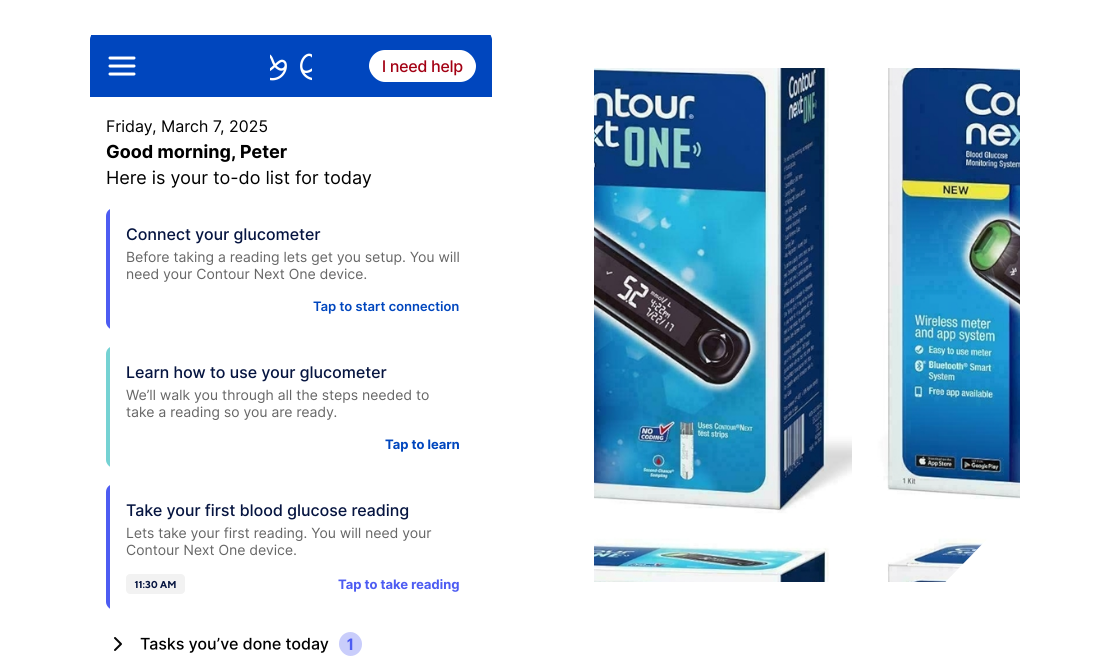
With the Contour Next One selected, I now needed to lead the design of the patient app and clinical dashboard experience for our first diabetes integration. Our patient population skewed elderly and low-literacy, and the design needed to work within commercial timeframes our sales commitments had set. Early testing showed two real problems: patients struggled to interact with the app while juggling lancets, testing strips and the device itself, and many were connecting the device incorrectly, which froze the glucometer and required a call to our support team to unlock.
Mapped the end-to-end patient journey from first unboxing through to ongoing daily readings
Identified three distinct phases of cognitive load: getting the device connected, learning how to use it, and
taking a reading in the moment
Designed an initial concept that split the patient journey into three sequenced stages, Connection, Education
and Reading, with each presented one at a time so patients could complete each successfully before moving on
Walked Engineering through the concept and identified two significant constraints: our backend didn't support
conditional logic, and dynamically ordering tasks was hard given that patients could have multiple devices and
readings to complete in a day
Ran a series of working sessions with Engineering to find a route that delivered the same outcome differently,
rather than descoping the user need
Worked closely with the Content Designer on my team to make sure prompts gave patients a clear sense of what
order to do things in
Ran usability testing on the revised approach with target users
Landed on a solution where the system created three separate tasks, automatically ordered by time, with logic
preventing overlap with other tasks
Connection issue was eliminated in further testing
Delivered within the commercial timeframe
Shipped the time-ordered task approach for the Contour integration, and reused the same pattern as a template for future device integrations.